The financial cost of ignoring your mental health
You鈥檙e running on five hours of sleep, holding down a job that鈥檚 draining the life out of you. Somehow, you still manage to show up for your kids, your partner, your aging parents, and that one friend who always seems to have it even worse. You are exhausted. And somewhere in the back of your mind, you know things aren鈥檛 quite right with your mental health. But therapy feels like something you just cannot afford right now.
Unfortunately, not getting the mental health support you need may actually be costing you more than the support itself ever would 鈥� in unearned money, in missed raises, in growing medical bills, and in the small ways we cope with emotional pain that feel good in the moment only to hurt us later.
Below, shares five ways that ignoring your mental health can empty your wallet.
1. Lost income due to missed work days or inability to focus
A 2022 Gallup poll found that U.S. workers rate their mental health as fair or poor, and those workers report about four times more unplanned absences than their counterparts with good mental health.
If you have an hourly job, that鈥檚 lost income; if you are in a salaried role, that鈥檚 an attendance pattern that will shape how management sees you and how quickly your name comes up when a promotion or raise is on the table.
And this is before we even get to presenteeism, aka showing up to work while functioning at a fraction of your capacity. You鈥檙e physically there, but not really engaged 鈥� you have brain fog, emotional exhaustion, difficulty concentrating. It鈥檚 hard to shine in a performance review when you鈥檙e just trying to survive the day.
2. Retail therapy and 鈥淚 deserve this鈥� spending
When emotional pain goes unaddressed, people find ways to manage it, just not always in healthy ways. Sometimes the coping strategy is expensive, sometimes very expensive.
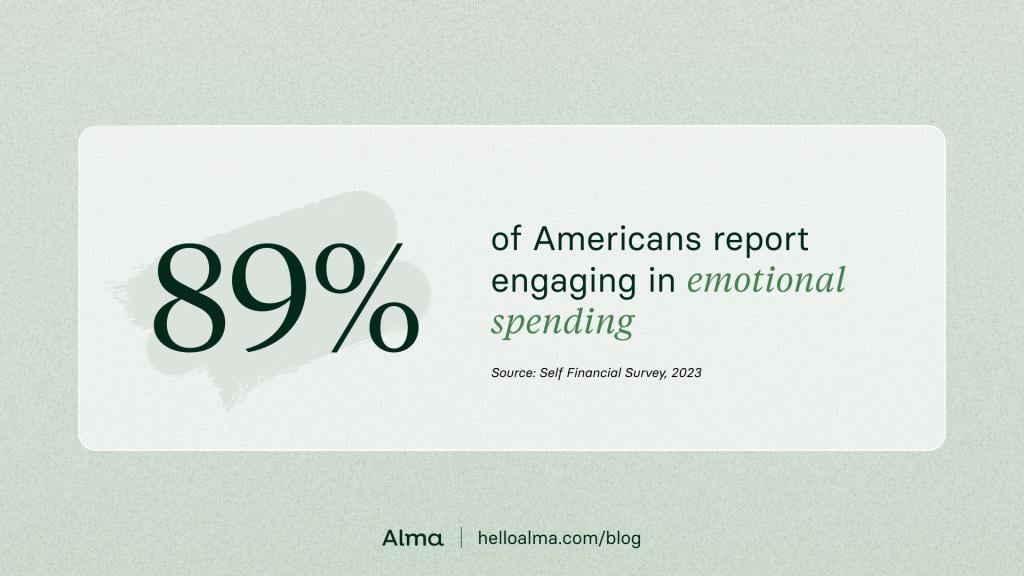
In a 2023 survey of over 1,000 Americans conducted by Self Financial, in some capacity. Over half said they bought new products purely to feel happier. The average emotional purchase runs about $65 each time, which might sound small until it happens several times a week.
For someone who is overwhelmed and quietly struggling, online shopping late at night becomes a coping mechanism. So does that extra beer or glass of wine after the kids go to bed, or the casino app on your phone. This is your nervous system responding to unmet emotional needs. And it has a line item in your budget whether you name it or not.
When we overfunction by running the household, managing everyone else鈥檚 stress, and never saying no, our brains start negotiating. You put in a brutal week and the mental calculus goes something like: I worked hard, I deserve this. A justification like that leads to purchases of things the budget simply cannot support.
You are not trying to be irresponsible; you just want to find a way to fill your tank back up. Unfortunately, shopping can鈥檛 restore your inner resources.
3. Staying in a job that doesn鈥檛 align with your passion or values
Untreated mental health struggles affect more than just keeping your job. It also means thriving versus surviving at work. The difference between the two can significantly impact your salary.
When anxiety, depression, burnout, unresolved trauma, or any other mental health struggle goes unaddressed, people frequently stay stuck in positions that don鈥檛 align with their values, their strengths, or their potential.
This is most often due to one鈥檚 mental state, making it nearly impossible to take risks, advocate for oneself, or pursue opportunities that require self-worth and a clear sense of direction.
According to the APA鈥檚 Stress in America 2025 Report identify work as a prominent source of stress, yet most won鈥檛 pursue mental health support that could fundamentally change how they show up and perform. As a result, those frequent absences and difficulty concentrating end up having real consequences for performance, like receiving negative reviews and missing out on promotions or pay increases.
Over the course of a 20-year career, staying stuck in a role that underpays, underutilizes, or undervalues you is not just emotionally costly. It represents a quantifiable and compounding financial loss: raises not pursued, promotions not sought, or a lateral move never made because the confidence wasn鈥檛 there to try.
4. Higher medical bills due to chronic pain and illness
People with untreated mental health issues of developing chronic health conditions, including heart disease, chronic pain, obesity, diabetes, and cancer. The stress and anxiety associated with unaddressed mental health problems can weaken the immune system, making the body more vulnerable to illness over time. To make matters worse, chronic health conditions often exacerbate mental health concerns.
Your mind and body are not separate systems; what you don鈥檛 process emotionally, your body processes physically. Chronic stress creates chronic inflammation, chronic inflammation creates chronic illness, and chronic illness creates medical bills. In many middle-class households, this cycle ends up creating medical debt.
Individuals who don鈥檛 receive treatment for mental health conditions in a timely manner are requiring more frequent hospitalization and higher overall healthcare spending, according to a School of Global Health at Meharry Medical College and the Deloitte Health Equity Institute report. These costs end up landing directly in your lap through higher premiums, out-of-pocket expenses, copays, missed workdays, and the ongoing financial strain of managing a condition that could have been caught earlier.
It is also important to mention the impact on one鈥檚 self-worth. When someone doesn鈥檛 fundamentally believe they matter, and their self-worth is quietly eroded by chronic stress, trauma, or years of putting everyone else first, they often stop making their own physical health a priority. Skipping the annual physical, ignoring symptoms, or delaying a needed scan. Down the road, they end up managing a condition at a far more advanced and expensive stage than necessary.
5. Combatting loneliness with more spending
Eighty percent of adults reporting a high level of loneliness according to the American Psychological Association鈥檚 2023 Work in America survey. Stress symptoms, including anxiety or feeling nervous, fatigue, and headaches, are far more common among those experiencing social disconnection.
Why does this matter for your wallet? People who feel isolated and unsupported are more likely to seek comfort through unhealthy coping strategies like unnecessary spending, using addictive substances, eating unhealthy foods, or engaging in avoidance or isolating behaviors.
Without a support system, people are more likely to stay in jobs or relationships that don鈥檛 serve them, because change feels impossible without anyone cheering them on. They are more likely to neglect physical health until a crisis forces the issue. Unfortunately, crises are almost always more expensive than prevention.
Loneliness is a risk factor for physical illness, for poor decision-making, and for financial instability. Connection is, among other things, a protective factor for you and your bank account.
Protecting your finances and mental wellbeing
From the outside, the financial side effects of unaddressed mental health can be hard to spot: a bank statement that doesn鈥檛 add up, a medical chart that keeps growing, a career that鈥檚 been idling for years, a lack of social support.
Consider therapy a financial decision that has a measurable return, even if you don鈥檛 feel it at the onset. Research examining the combination of therapy and medication for adults who were managing a chronic physical condition found that this approach , or approximately $2,700 per person. That鈥檚 money that could go to car payments, childcare, or even a family vacation.
If the behaviors above are all too familiar, it may be time to reframe your thinking: Mental health neglect can cost you far more than mental health care. The therapy session you skip to save on a $20 weekly co-pay may cost you three times that in impulse purchases, missed workdays, or a medical appointment you could have avoided entirely.
was produced by and reviewed and distributed by 黑料社.