
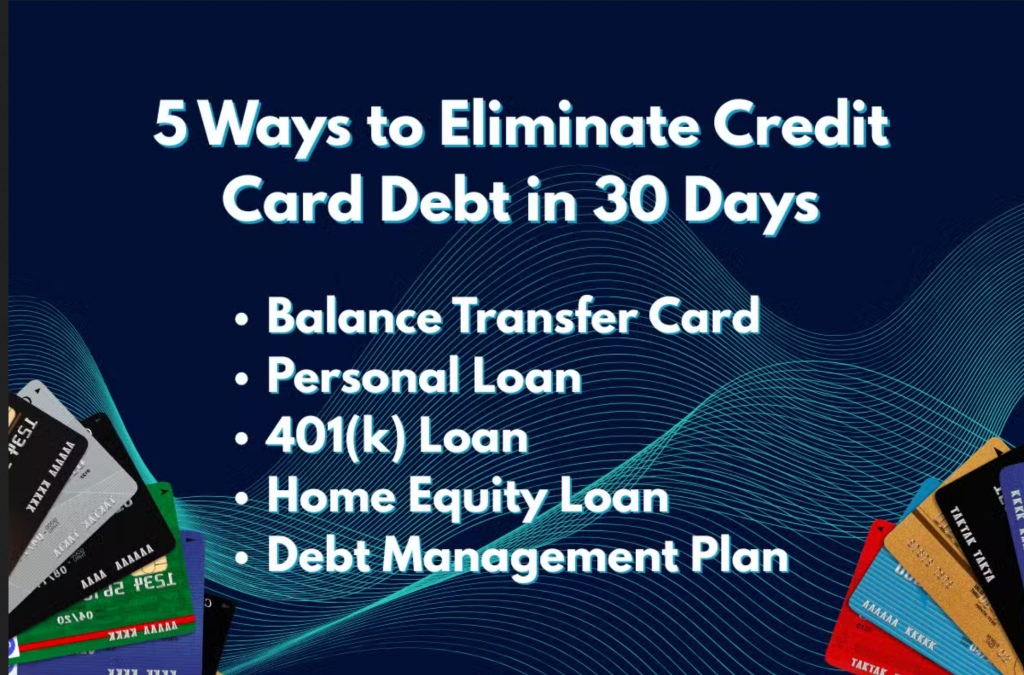
5 ways to eliminate credit card debt in 30 days
Credit card debt can feel overwhelming, especially when high interest makes it harder to make progress. For that reason, shared five tested ways to get rid of your credit card debt in 30 days, all without needing to earn another dollar.
Key Takeaways
- Some ways to eliminate credit card debt include using a balance transfer card to cut interest, consolidating balances with a personal loan, borrowing strategically from a 401(k), leveraging home equity, or enrolling in a debt management plan to lower rates and simplify payments.
- Balance transfer cards and personal loans work best for fast relief because they immediately reduce high interest, freeing more of your payment to attack the principal.
- Borrowing against assets like a 401(k) or home equity can drastically lower interest costs, but only makes sense with stable income due to serious repayment and collateral risks.
- Debt management plans don鈥檛 require new loans and can improve credit over time, but they take longer to set up and are better for long-term stability than quick payoff.
Using Balance Transfer Cards
The first way is by getting a balance transfer credit card, which is similar to a . Say you鈥檝e got a bunch of credit card debt on your current credit card at 25% interest every month, which eats away at your finances. You don鈥檛 know what to do. Well, if your is high enough, you could apply for a balance transfer credit card that transfers your debt from the previous card with 25% interest to a new credit card with 0% interest for the first 12 to 18 months. It usually takes just a few days to set up.
A balance transfer card may be worth it because it鈥檚 going to give you a lot of breathing room to tackle without being bogged down by interest fees. So, what鈥檚 the catch? Firstly, if you don鈥檛 have a credit score above 690, it鈥檒l be hard to get approved for a credit card with 0%. If you鈥檙e in that 580-669 range, you might be able to qualify for a balanced transfer card, but your rate might be closer to 10%, which is better than your current APR. However, keep in mind, these low rates are temporary, just like the 0% interest, and after six months to a year, they will shoot back up to the mid-20s.
The second catch is that 0% interest may come with a of the total amount you transfer. So, if you鈥檙e transferring $10,000 worth of credit card debt, you could be looking at a transfer fee between $3 and $500. But this is still a great option if the transfer fee is less than the interest you would pay over time, which it usually is.
Using Personal Loans
The next way to get rid of credit card debt is to get a personal loan to pay off high credit card balances. This option is a favorite amongst people who are looking to combine a bunch of different debts into just one loan, aka debt consolidation, or if they鈥檙e looking to take a high-interest credit card debt and trade it for a personal loan with a lower interest rate. Personal loans can be a good option because, with debt consolidation, instead of dealing with a bunch of different credit card companies all sending you different letters and written warnings, you can just deal with one company. And that also means you only have to keep track of one bill instead of 10.
Even if your credit score isn鈥檛 the best, there are different personal loans out there for all credit score ranges. Regardless of what personal loan you end up going with, remember to pay down the debt aggressively. The goal is to eliminate debt, not just transfer it to another account.
Using a 401(k) Loan
The next method for eliminating credit card debt is borrowing against your 401(k) employer plan. Now, this can be risky, but it might make sense for you if you have an employer-sponsored retirement plan but also have a low credit score.
If your employer鈥檚 retirement plan allows it, you can typically or 50% of your 401(k) balance, whichever is less. There鈥檚 no credit check because you鈥檙e technically borrowing your own money. That means the is usually in the single digits instead of 20% or more. Not to mention, instead of paying interest to the loan provider, the interest paid on your 401(k) loan goes right back to your retirement account. And once you request the loan, it usually takes a few days to a couple of weeks to get the money. You can then use it to pay off your high-interest debt in one shot. From there, you start paying the loan back through payroll deductions. And because it comes out of your paycheck automatically, it鈥檚 pretty easy to stay on track with repayments.
But that certainly doesn鈥檛 mean it鈥檚 not without a lot of risk. If you leave your job or get laid off, most 401(k) plans require you to pay back the full balance quickly, sometimes within 60 to 90 days. And if you can鈥檛 do that, the IRS may charge income taxes on it and probably a 10% early withdrawal penalty if you鈥檙e under 60. So, it鈥檚 vital that you have a super stable job if you want to use this method.
Using a Home Equity Loan
A gives you a lump sum payment, and a HELOC gives you a flexible line of credit. Both offer lower interest rates than credit cards because, like the 401(k) plan, you鈥檙e offering something valuable as . In this case, your home. So, once again, only consider this option if you鈥檙e confident you can handle the payments and you鈥檝e got a stable income.
Using a Debt Management Plan
A debt management plan (DMP) could help you get your credit card debt under control without borrowing more money. Here鈥檚 how it generally works:
- You talk to a credit counselor. They take a look at everything you owe, and then you go to your credit card companies to negotiate lower interest rates for you.
- If the creditors agree, your interest rates drop, and your payments get rolled into one monthly payment that you send to the agency.
- The credit counselor handles the rest, making sure your credit card companies get paid on time every month.
Enrolling in a DMP doesn鈥檛 hurt your credit score. And in many cases, your score starts to go up as your balances go down and your payment history gets back on track. So, it鈥檚 a solid option for people who are overwhelmed with minimum payments, need lower interest, but don鈥檛 want or can鈥檛 qualify for a , but it鈥檚 probably not the best option if you鈥檙e looking for fast results. Because if you contact a nonprofit credit counselor now, it will probably take a few weeks to set up your DMP.
was produced by and reviewed and distributed by 黑料社.