
The 9 compliance risks hiding in your organization and how to fix them
Per , 85% of organizations report that compliance requirements have become more complex over the past three years, increasing the risk of non-compliance and violations or fines.
Compliance now coexists with evolving vulnerabilities, from AI adoption and higher cybersecurity risks. Organizations face tighter scrutiny from regulators, customers, and partners, where even a minor gap can lead to penalties, operational disruptions, and lost trust.鈥�
To help you navigate the growing complexity of managing compliance risk, this guide from agentic trust platform will cover the different types of compliance risks with examples, as well as steps to assess and manage compliance risks effectively.
What is compliance risk?
Compliance risk is the potential legal, operational, or financial exposure an organization faces if it fails to comply with applicable laws, regulations, or internal rules or policies. It isn鈥檛 limited to one industry or function and can lead to consequences such as:
- Financial penalties
- Legal action
- Reputational damage
- Loss of trust among stakeholders
Compliance risk doesn鈥檛 always stem from deliberate misconduct. It can also arise from minor oversights, outdated processes, or even misinterpreted regulations. Data suggests unintentional mistakes are more common, with benchmarking data reporting that over 96% of privacy incidents are unintentional.
What adds to the complexity is the evolving nature of compliance risk. Systems and processes that are compliant today can quickly become non-compliant as regulations, business models, and technologies change, which is why is an ongoing process.
What are the types of compliance risk?
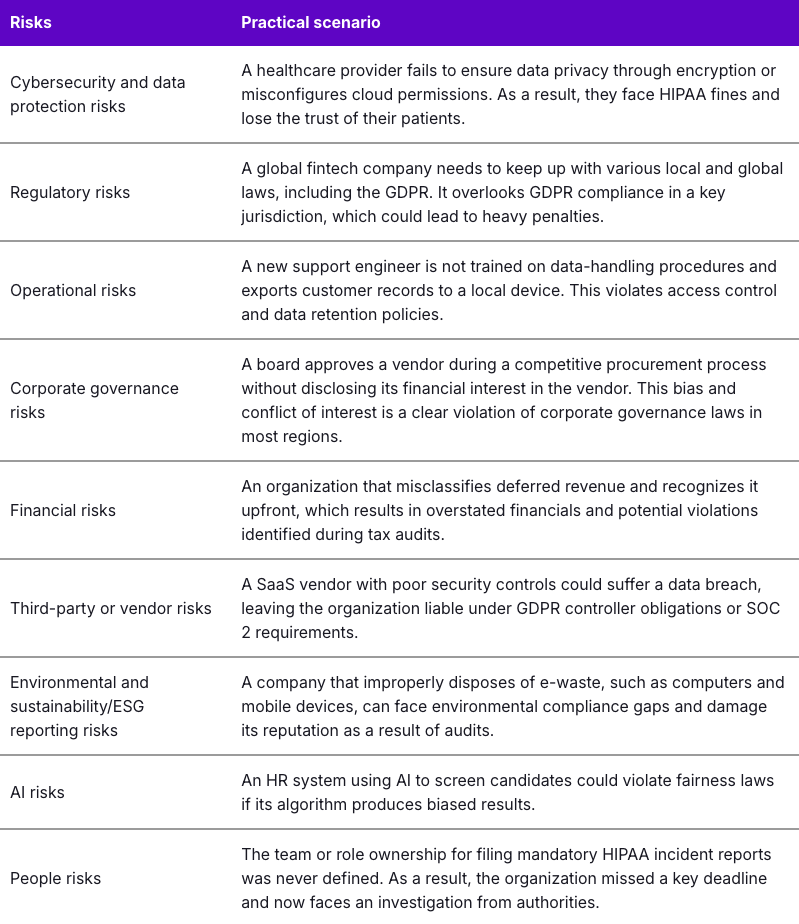
Compliance risks can vary, depending on the organization鈥檚 size, industry, and location. Aligning with themes in the helps map out some of the most high-priority compliance risks today: 鈥�
- and risks: As organizations rely more heavily on cloud systems, the risk of data breaches and cyberattacks is rising. Protecting personal and sensitive records has become a top priority, particularly in healthcare where is often one of the first steps.
- Regulatory risks: Laws and regulations are constantly changing, making it easy to overlook updates. The risk is compounded for organizations meeting several compliance frameworks across jurisdictions.
- Operational risks: These arise when internal processes, systems, or controls fail to meet regulatory or policy requirements. They can be caused by human error, inefficient workflows, or incomplete documentation.
- Corporate governance risks: These risks relate to how the organization is directed and controlled. Poor corporate governance practices, including unethical conduct and a lack of transparency, can lead to regulatory scrutiny and reputational harm.
- Financial risks: Errors in reporting, accounting, or internal controls can result in fines, penalties, or the misrepresentation of financial statements. This is why accurate and transparent financial practices are so important.
- or : If a vendor doesn鈥檛 comply with regulations or mishandles data, the resulting compliance exposure often extends to the organization itself. Many regulations hold the parent organization accountable, even if it outsources data handling services.
- Environmental, social, and governance (ESG) reporting risks: ESG disclosures are now mandatory in many regions. Misreporting, also known as 鈥済reenwashing,鈥� could lead to penalties and investor backlash.
- : When organizations adopt new AI technology, they open themselves up to new risks, such as algorithm bias, transparency, and data governance, which can violate data privacy regulations.
- People risks: The most unpredictable risks are driven by human behavior. Incomplete training, oversights, and unclear roles and responsibilities can easily lead to compliance violations.
鈥嶁�淐ompliance failures are often rooted in people risks, especially unclear accountability,鈥� says Jill Henriques, a compliance specialist at Vanta and an expert in governance, risk, and compliance (GRC). 鈥淲ithout defined roles and ownership for prioritizing compliance-related tasks, organizations will struggle to meet requirements consistently. Compliance must be driven across functions, not delegated solely to GRC teams.鈥�
How to assess and manage compliance risk
To effectively evaluate and manage common compliance risks, follow these steps:
- Scope your compliance obligations, systems, and task flows.
- Evaluate risks and control gaps.
- Plan and implement risk treatments.
- and mitigation strategies.
Step 1: Scope your compliance obligations, systems, and task flows
Map every compliance requirement that governs your organization, including regulatory, framework, contractual, and internal requirements.鈥�
You鈥檒l also need to map where compliance requirements intersect with daily processes, so it鈥檚 best to collaborate with cross-functional teams鈥攕uch as HR, IT, legal, finance, and security鈥攖o source vital information and avoid data silos.
鈥岲iscuss considerations like which department generates sensitive data, who has access to which records, where those records are stored, and if third parties are involved. Next, create a list of departments and activities that could pose a compliance risk.
鈥岮 good strategy is to map your data flows to identify sensitive spots. Sensitive data flows may be governed by stronger compliance requirements, so they require structured protections. Particularly, understand:
- Where sensitive data comes from
- Where it lives
- Who accesses it
- How it鈥檚 modified
- How long it is stored鈥�
Be mindful of hidden shadow systems or undocumented workflows, often driven by employees, as they can easily bypass internal controls and trigger untracked compliance risks. A solution here is to train teams on why compliance exists so they can make better value-based decisions in new or unspecified scenarios.
Step 2: Evaluate risks and control gaps
Next, compare your current controls and procedures against scoped regulatory and policy requirements to identify compliance gaps. Besides validating documented controls, you should interview relevant teams or conduct to uncover unaddressed risks.
All your findings should be recorded in a centralized risk register. Make sure that you thoroughly describe each identified risk by including:
- Description of the issue
- Risk score based on their impact and likelihood
- Ownership
In complex compliance environments, risk evaluation must also factor in overlapping obligations and shared responsibilities in third-party relationships. Compliance risk can be quite unpredictable in interdependent systems and teams, so it's important to have the for proactive SLA controls and regular external assessments to detect high-stakes gaps early.鈥�
Another complex scenario is when two or more regulations have conflicting requirements. For example, the GDPR鈥檚 data minimization principle could conflict with another country鈥檚 data retention requirements. In such cases, it鈥檚 best to consult with compliance experts.
Step 3: Plan and implement risk treatments
Once you identify gaps, prioritize remediation based on severity, compliance deadlines, and business risk. The main mitigation strategies are:鈥�
- Eliminating the risk
- Mitigating the risk
- Transferring the risk
- Formally accepting the risk based on what the regulation allows
For example, some healthcare organizations may accept certain when encryption isn鈥檛 technically feasible, and document their justification and mitigation measures with legal and risk exception process or approval.鈥�
To ensure accountability and tracking progress, define a remediation timeline, task owners, and success criteria. Maintain thorough documentation of remediations done鈥攚ith rationale if necessary鈥攖o support potential regulatory or compliance audits.鈥�
Tip: You can use for step-by-step guidance on governance and remediation specific to your compliance landscape.
Step 4: Continuously monitor risks and mitigation strategies
Considering that technological evolution is relentless and new regulations consistently emerge, you need to regularly refresh risk assessments and treatment plans.
Establish a workflow to continuously track compliance components, maintain evidence, and validate that controls function as intended. Setting a cadence for routine control checks or vulnerability scans with the right can help you stay audit-ready.鈥�
For example, you can conduct quarterly control checks and annual deep-dive assessments aligned to certification cycles, such as , , and . Some , such as the or may also require monthly checks and reporting, so early can help you plan for these cadences.鈥�
You must also religiously update the risk register when:鈥�
- New regulations take effect
- New markets or data types are added
- Tools, scope, and infrastructure change
- An audit or incident uncovers a gap鈥�
If the budget allows, organizations have a dedicated compliance officer or to oversee these activities, often relying on to maintain visibility across the departments. Small and medium businesses usually don't have dedicated risk management roles. They typically rely on their legal team to address contract, vendor, or privacy risks, while the CISO might be responsible for information security risks.
Best practices for compliance risk management
Follow these best practices to build a resilient compliance program and keep your compliance risk under control:
- Stress test under various scenarios: Simulate incidents such as data breaches or system failures to evaluate how your controls respond, and train your team to address such situations.
- Build documented processes: Accurate and comprehensive documentation is essential for proper scoping and audit readiness.
- Provide staff training for compliance risks: Human factor is one of the main variables in compliance risk. Educate your team on how to recognize and respond to compliance risks and prepare a knowledge base for written reference.
- Use automated risk management solutions: To reduce manual effort, minimize errors, and ensure that risks are continuously monitored, rely on . It can drastically cut audit preparation time by centralizing evidence collection and streamlining documentation. These tools can also help with expert tasks typically handled by compliance officers, such as writing and managing policies, as well as provide real-time compliance status and generate reports.
FAQs
How often should compliance risks be assessed?
The general best practice is to assess compliance risks quarterly or annually. Consider more frequent assessments if regulations are more volatile, significant system changes occur, or when you introduce new products or processes.
Who is responsible for managing compliance risk?
The leadership and compliance officers are primarily responsible for managing compliance risk. However, each department needs to contribute and can be held accountable internally for individual processes, controls, and policy updates.
Can automation replace manual compliance audits?
can鈥檛 fully replace manual audits, but they can streamline the busywork in the audit process by collecting evidence, testing controls, and monitoring risks.鈥�
What are the most common compliance frameworks?
According to , the most common and widely-adopted compliance frameworks are , , and .
was produced by and reviewed and distributed by 黑料社.