The controversies surrounding the new Theodore Roosevelt Presidential Library
In case you haven’t heard the very bully news, the Theodore Roosevelt Presidential Library—which opens on July 4 in the tiny town of Medora, North Dakota—is a stunning architectural, archival, and multimedia achievement, a world-class memorial to a president who became the first great champion of American public lands and conservation.
It’s also a project with built-in controversies that can’t be ignored, including Roosevelt’s views on Indigenous people.
“The most ultimately righteous of all wars is a war with savages, though it is apt to be also the most terrible and inhuman,” he wrote in “The Winning of the West,” a bestselling, four-volume epic that rolled out starting in 1889. “ … [I]t is of incalculable importance that America, Australia, and Siberia should pass out of the hands of their red, black, and yellow aboriginal owners, and become the heritage of the dominant world races.” In the four volumes, he used “savages” or a close variant more than 300 times.
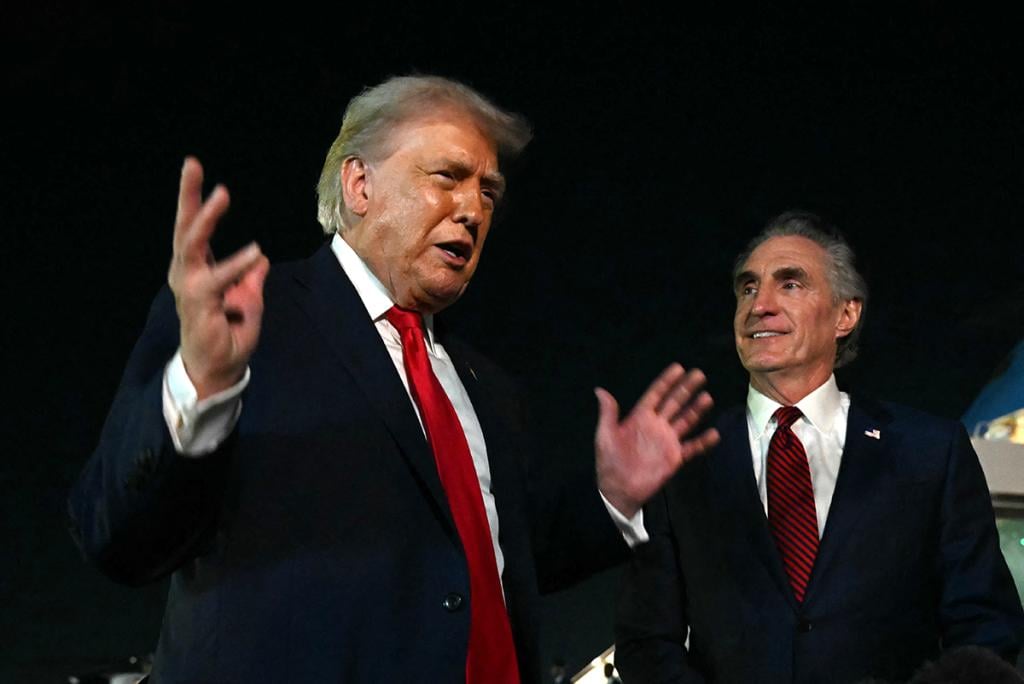
Another controversy is this: The man who did as much as anyone to help the library reach its impressive scale—Doug Burgum, the current U.S. secretary of the interior—has overseen deep cuts to public-lands agencies during Donald Trump’s administration.
Burgum is not on the library’s board, but in 2018, when he was North Dakota’s governor, he led the way in amping up a set of relatively modest, preexisting plans for a T.R. presidential library in the college town of Dickinson, moving the whole thing 35 miles west to Medora and making it much bigger and bolder. As secretary of the interior, he has supported every stage of Trump’s second administration, which has rescinded many long-standing federal land stewardship policies while dramatically ramping up lease sales to extractive industries.. The most recent example: Interior’s May 11 repeal of the Public Lands Rule, which had given conservation the same priority status as extractive uses like mining, grazing, and drilling.
“That’s the greatest conundrum with all this,” said Shannon Straight, executive director of the Badlands Conservation Alliance, a nonprofit that works to protect wild places in North Dakota. “Theodore Roosevelt understood the need to balance extractive industry with conservation, in order to leave something for future generations. It’s really ironic that Doug Burgum has been pushing for this library while filling a role where he’s unraveling T.R.’s conservation legacy right before our eyes.”
Library officials have made it clear that Roosevelt’s racial attitudes will be addressed in various ways—but, so far, they aren’t confronting criticisms like Straight’s head-on. The library’s media relations team declined to provide a spokesperson to talk about Burgum with , or to arrange an interview with library board member Douglas Brinkley—author of “The Wilderness Warrior,” a massive 2009 history of a president he called “a conservation visionary.”
“This #EarthDay, we celebrate the president who did more to protect America’s land than any other,” on April 22. “During his time in office, Theodore Roosevelt protected approximately 230 million acres of public land. He established the United States Forest Service. He created 5 national parks, 150 national forests, 51 federal bird reserves, 4 national game preserves, and 18 national monuments through the 1906 Antiquities Act.”
Indeed, he did. And those accomplishments are now facing myriad policy changes at the federal level.
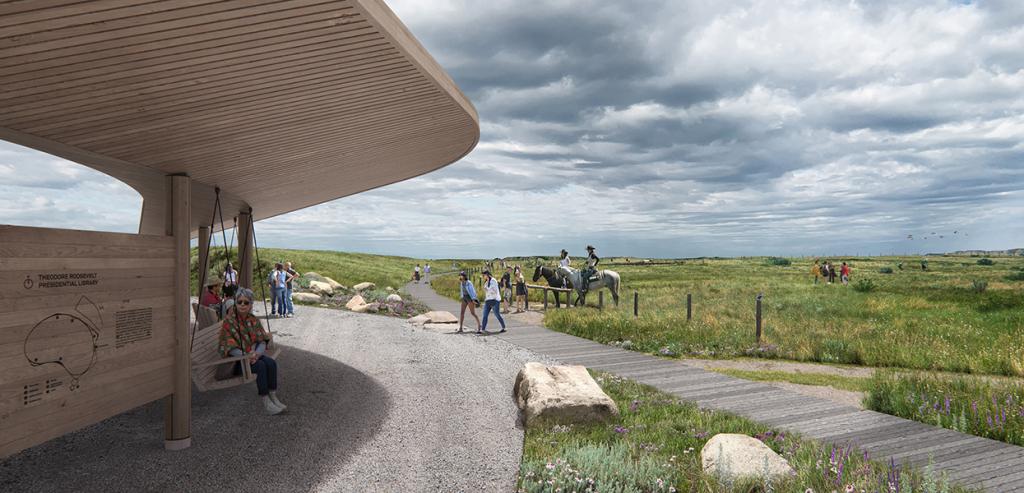
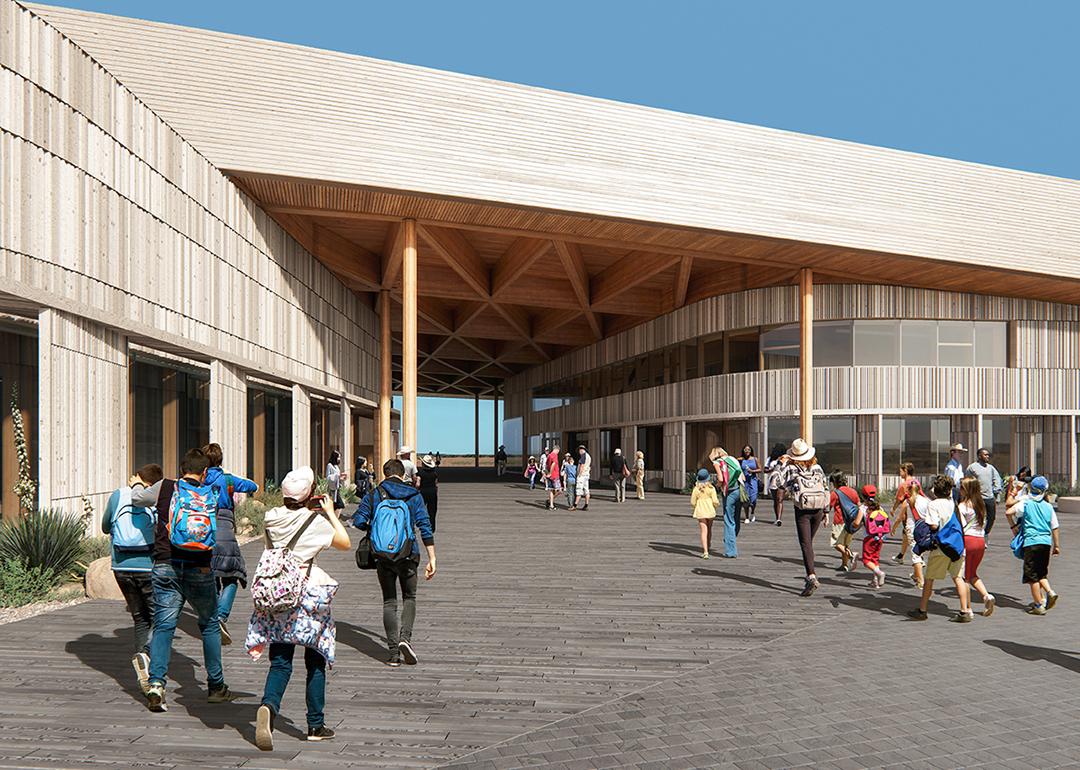
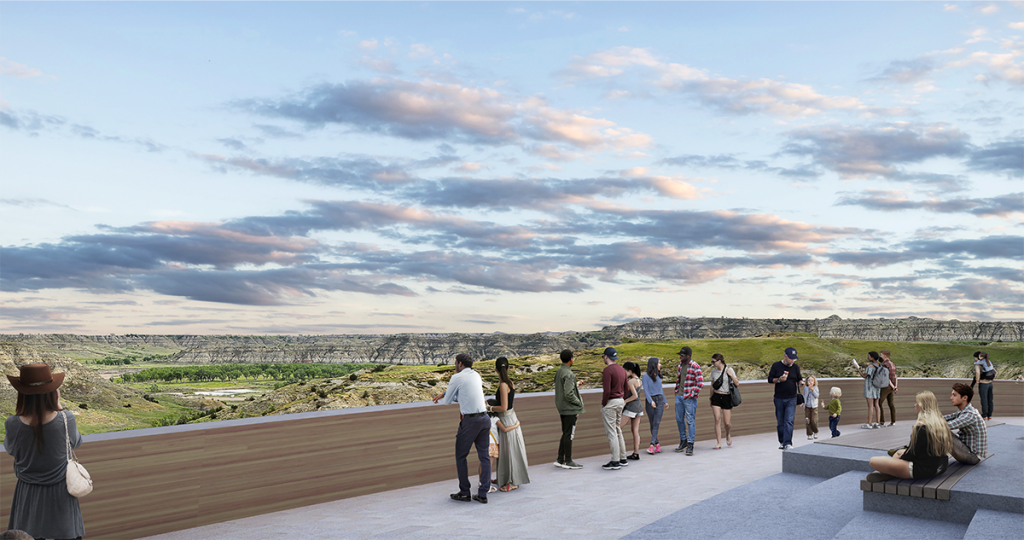
Set amid scenic grasslands right beside the Maah Daah Hey Trail—a 144-mile singletrack route for bikers, hikers, and horseback riders that connects all three units of Theodore Roosevelt National Park—the $450 million library is built on 90.3 acres of land purchased in 2022 from the U.S. Forest Service by Roosevelt’s descendants. (Two of his great-great-grandsons, Kermit Roosevelt III and Theodore Roosevelt V, are on the library’s board.) It will open with a splash as a presidential museum and interactive experience that could turn the North Dakota Badlands into a formidable draw for warm-weather tourists. (Most people are expected to visit in the summer; in January, North Dakota’s average temperature is 10.5 Fahrenheit.)
The library will be housed in a beautiful, eco-friendly building designed by Snøhetta, a Norwegian firm that also drew up the National September 11 Memorial Museum Pavilion, in New York City, and the Shanghai Grand Opera House. One of its many innovative features is a two-acre “living roof” planted with more than 200,000 native species.
The spirit of sustainability doesn’t end there. “The project’s design’s … ambition can be best divided into four categories: Zero Energy, Zero Water, Zero Emissions, and Zero Waste,” . “This approach relies on a carefully calibrated combination of passive strategies and active technologies throughout the site and building.” The library is pursuing LEED and SITES certification, along with Living Building Challenge Certification, which its fact sheet calls “the world’s most rigorous performance standard for green buildings.”
All of which amounts to a major style adjustment for Medora, a historic ranching community and tourism town whose population usually stays below 200. Founded in 1883 by a Frenchman whom T.R. came to know very well—Antoine de Vallombrosa, the Marquis de Morès—Medora is the gateway to the southern unit of the national park, which was established in 1947.
Burgum’s staff at Interior didn’t respond to RE:PUBLIC’s request for an interview about the library. But he discussed it at length during a recent conference hosted by the Outdoor Recreation Roundtable (ORR), a Washington D.C.-based nonprofit that represents trade groups and businesses that help make up America’s $1.3 trillion outdoor economy. Burgum, a South Dakota native, tech executive, two-term governor, and Teddy Roosevelt superfan, spoke positively about the project.
“A $450 million project was the goal,” he said during a Q&A with Frank Hugelmeyer, an outdoor industry executive. “They blew through that this spring. They’ll probably end up raising over $500 million in this initial preopening phase.” Burgum has often called the library “North Dakota’s Mount Rushmore.” At ORR, he spoke with a booster’s enthusiasm about features that will put it in the same league as big-time theme parks—calling it “more Disney than dust.”
“This is a place where your kids and grandkids will be dragging you, not the other way around,” he said. “You get to the end, you’re going to be surrounded by the words of the ‘In the Arena’ speech,” he added, explaining that the library will deploy a Large Language Model to turn Roosevelt’s prodigious verbal output into an “A.I. Teddy, [an] avatar” that can field and address visitors’ questions.
“He will answer in words that he either spoke or wrote during his lifetime,” Burgum said. “I think every museum in the country is gonna go, ‘Oh, we need one of those.’”
Roosevelt, a progressive Republican, called conservation “a national duty” in a famous 1908 speech. During the interview, Burgum uttered the word only in passing—for instance, when he touted the library as a setting for virtual board meetings for groups like those at ORR. But the C-word could come back to haunt the project’s publicists, since there’s no shortage of examples that illustrate the vast ideological chasm between T.R. and Trump.
Burgum brought one to mind himself when he talked about the Maah Daah Hey Trail and its proximity to the new facility, saying, “This is the first presidential library that you could hike to, ride a mountain bike to, and, yes, there is a way placed right in front of the library to tie up your horse if you decide to ride a horse.”
He failed to mention that the Bureau of Land Management (BLM)—a federal agency he runs—recently opened the trail up to potentially destructive oil and gas development. On April 28, as part of Burgum’s “energy dominance” strategy, the BLM sold 23 drilling parcels that are either close to the trail or right on top of it. Another lease sale planned for August includes additional parcels that overlap the trail or are close to the national park.
Nor did Burgum mention how much the library owes to oil and gas industry largesse. Oklahoma-based billionaire Harold Hamm, who donated $50 million to the project, amassed part of his fortune by extracting North Dakota fossil fuel—some of it through a lease deal agreement between his company, Continental Resources, and Burgum’s family. In 2024, Hamm was a major backer of Burgum’s unsuccessful presidential campaign. According to various , he and Burgum later held a fundraiser at Mar-a-Lago where fossil-fuel executives were assured that large donations to Trump would lead to environmental rollbacks favorable to their industry.
Hilary Hamm, one of Hamm’s daughters, is chair of the library’s executive committee—a top leadership position on the board. She lives and works in Washington D.C., serving as director of federal affairs and corporate sustainability for Continental Resources.
Burgum is expected to attend the library’s sold-out grand opening on the Fourth. On May 6, a spokesperson for the library told The North Dakota Monitor that they’ve also received “positive inclinations on a potential visit from the president.”
Two frequently asked questions: Why isn’t there already a Theodore Roosevelt presidential library? And why is this one in North Dakota instead of New York State, where T.R. grew up, got his start in politics, and served as governor?
Without a doubt, Roosevelt has long warranted a stately repository—his life was as colorful, eventful, and intellectually rich as that of any chief executive—but presidential libraries didn’t exist when he left office by choice in 1909.
The system we have today began to take shape in 1939, when President Franklin D. Roosevelt (T.R.’s distant cousin) donated his papers to the federal government—the foundation for what became the FDR library and museum in Hyde Park, New York. Congress passed the Presidential Libraries Act in 1955, putting the facilities under the management of what is now the National Archives and Records Administration (NARA).
As for T.R., most of his papers and other archival materials went to Harvard, his alma mater, and the Library of Congress. The new library is a private nonprofit that isn’t part of the presidential library system. The Obama Presidential Center, which opens in Chicago on June 19 and costs an estimated $850 million, is also privately funded. But it’s part of the system, and NARA will retain legal and physical custody of records and artifacts at a storage facility in College Park, Maryland.
The North Dakota location commemorates a period in Roosevelt’s life that’s long been a source of pride in the state. His deep connection to the Badlands was forged in the aftermath of an unimaginable tragedy: the deaths on the same day, Feb. 14, 1884, of his mother, Martha, and his wife, Alice, who had given birth to the couple’s first child only two days earlier.
Roosevelt, then in his third term in the New York State Assembly, had traveled to the Dakota Territory in 1883 to hunt buffalo; while there, he purchased a stake in a cattle ranch near Medora. He went back to the Badlands in the summer of 1884, living and working there off and on for less than a year, and establishing a second ranch called Elkhorn, situated 35 miles north of Medora along the Little Missouri River.
Roosevelt came and went during his Dakota years—returning to the east, among other reasons, to run unsuccessfully for mayor of New York City and to get married a second time, an event that happened way, way back east in London. He started to move away from ranching after the devastating, cattle-killing winter of 1886-1887, which occurred when he was still honeymooning in England.
Even so, Roosevelt left no doubt that his experiences in the Badlands—where he proved his worth as a working horseman and all-around tough guy to locals who at first regarded him as an effete, four-eyed weirdo—were transformative. In a 1910 speech delivered at the dedication of a college library in Fargo, he said that, without his experiences in North Dakota, “I never in the world would have been president.”
The idea of honoring this rich history with an in-state library predated Burgum by many years. The original plan was to house it at Dickinson State University, which, since 2007, has been home to a scholarly hub called the Theodore Roosevelt Center. The core concept was to digitize a huge amount of the Roosevelt materials housed at Harvard, the LOC, and other institutions, in part to make them more accessible to people who lived far away from the East. By that point, the Roosevelt Center had already digitized roughly 50,000 documents.
This project evolved and grew. By 2016, according to an account in The Dickinson Press, plans were afoot for the construction of a major new museum on campus, complete with an elaborate design concept done on commission by JLG, an architectural firm with offices in North Dakota, South Dakota, and Minnesota.
“It’s a sweeping vision in which an entire 26-acre city block smack dab in the middle of Dickinson would be transformed into a faux Badlands setting,” the paper explained, “with millions of dollars in landscaping to create earthen berms and a man-made creek accentuating the impressive library and museum complex designed to invoke the Badlands Roosevelt so loved.” At the time, planners projected the library would open in 2019.
Part of the vision was to build an authentic replica of the Elkhorn Ranch cabin, using only the methods and materials that would have been available in the 1880s: axes, saws, hand drills, ropes, pulleys, human brawn, and four-legged horsepower. JLG produced a beautiful set of plans for this replica, and the logs required to build it had already been felled and transported to the Dickinson State campus. The goal was to build a reproduction that could be maintained to last for a hundred years. (Though JLG’s Dickinson plans weren’t used, it has worked in a partnership with Snøhetta, performing crucial work in design, construction, and landscaping.)
Most of the Dickinson-centric ideas were left behind after Burgum became governor in late 2016. He took office in December; a little over one year later, at a meeting in Medora, he called for something more.
“This is an invitation to think bigger, to think bolder, to think grander—to think how T.R. would think,” he said. “[T]here’s no one who is here to pitch a specific idea or a specific location. What we’re here to do today is find out how high is up.”
Dickinson got bigfooted less than a month later, when a dramatic change of plans was unveiled. The digital arm would still be housed at DSU, but the museum would be moved to Medora.
Developments revved up after that. In 2019, the state legislature authorized a $50 million operations endowment for the Medora project, with the stipulation that it be matched by $100 million in private donations. Later that year, a dozen leading architectural firms—among them Ennead in New York City, Henning Larsen in Copenhagen, and Snøhetta—were invited to submit designs. Three finalists came to Medora during the COVID-19 pandemic to present their ideas. The library board had told them all to produce a design that “transcends time.”
North Dakotans are a resilient bunch, but the abrupt shift from Dickinson to Medora left a few bruises.
“Up until six months ago, this thing was going fine,” Rich Wardner, majority leader of the North Dakota Senate and a proponent of the Dickinson State plan, said at the time. “And now it’s been hijacked, and I’m a little bit miffed about it. … It irritates me, [the governor] comes in, Johnny-come-lately, and he starts wanting to take over the project.”
The prime mover for the DSU plan was Clay S. Jenkinson, a wide-ranging scholar, T.R. expert, and historical reenactor who has appeared in a number of Ken Burns documentaries, including “The Roosevelts: An Intimate History, and The National Parks: America’s Best Idea.” Jenkinson supports the Medora library—“God bless them,” he said, “and I hope their success is stunning”—but he also thinks the way the transition was handled was wasteful and short on grace.
He particularly mourns the cabin project, planning for which was quite far along. Part of the effort involved persuading more than 50 ranchers in the Little Missouri River valley to permit the harvest of cottonwood trees from their land. These were to be labeled for use in the finished, 1,800-square-foot structure, which had been placed in the hands of a master craftsman named Richard Bickel.
“North Dakota is the most treeless place in North America, without question,” Jenkinson said. “I still feel real moral angst about asking these ranchers to do this for us, only to have it be dropped—at least temporarily. I don’t know what the long-term plans are for the presidential library people. But for the short term, there’s been no interest in building the cabin.”
“There was a lot of heartache about the decision to take the library out of Dickinson,” said John Hanson, a rancher who drew on his extensive contacts in the ranch community to organize the tree harvesting. “At the time, we were told that there was no place for the cabin to land in Medora.”
Wardner, now retired, hopes the cabin will be built someday. “We’re still dreaming,” he said. “We still think we can get it.” He believes it should go up right beside the Roosevelt Center at DSU. Meanwhile, he takes great pride in what has been accomplished on the campus, where the has processed approximately 135,000 records from more than .
Though the Medora library has no use for the cabin, it has taken possession of something far more controversial: the Theodore Roosevelt equestrian statue that, from 1940 to 2021, stood outside the American Museum of Natural History in New York City. The statue, a massive bronze, depicts Roosevelt on horseback, riding high in the saddle above two shirtless men: one African, the other Native American. It was taken down in response to years of protests about its symbolism of white racial superiority.
In late 2021, the library announced that it had entered into an agreement with city officials for “the long-term loan and reconsideration” of the statue, which is now in storage as part of its archival holdings.
The agreement allows the library to keep the statue “while considering a display that would enable it to serve as an important tool to study the nation’s past.” With support from members of the Roosevelt family, the release said, the library would establish an advisory council—with representation from “the Indigenous Tribal and Black communities”—to guide the recontextualization process.
That sounded like they were planning to display it again, albeit with a warning label attached. But in a New York Times curtain-raiser about the library published in 2023, Edward O’Keefe, the library’s chief executive officer, assured the paper that the statue will not be displayed when the library opens, acknowledging that it’s now considered “radioactive” by many people. Asked why the library took possession to begin with, O’Keefe said officials had an “obligation to confront ‘hard things.’”
The library didn’t respond to a request for information about the statue’s current whereabouts and status.
While Roosevelt deserves to be pilloried for any racist statements he made, the new library will play an important role by providing balance and context. He was a maverick whose presidency played out during an era when conservation was still a developing concept—one seen by many businessmen and politicians as an unacceptable barrier to unfettered capitalism. If he hadn’t existed, it’s difficult to say when, or if, anything resembling what he accomplished would have taken place.
Among the shelfloads of books published about T.R., one that captures the times particularly well is Timothy Egan’s “The Big Burn,” a 2009 history of how the fledgling U.S. Forest Service—created by Roosevelt and Gifford Pinchot in 1905—fought apocalyptic forest fires in Idaho, Montana, and Washington that blazed during the summer of 1910.
In Roosevelt’s first message to Congress, Egan wrote, he had said that proper care of the nation’s forests—and the fresh water they supply—should be counted among “the most vital internal question of the United States.”
He backed that up with action; a typical skirmish in the endless struggle happened in 1907, when Idaho Senator Weldon Heyburn—an opponent of the very idea of national forests—introduced an appropriations bill amendment that took away the president’s authority to create new national forests in large parts of the West without congressional approval.
By law, Roosevelt had one week to sign it, which had to happen to avoid a government shutdown. Pinchot said they should use that time productively, by identifying land that could be added to the system through executive order, bypassing Congress.
“For a week, a huddle of [forest service employees] worked nonstop to outline valleys and rivers, mountain ranges and high meadows, ridge after ridge of forestland that might qualify” for protection, Egan wrote. “The floor of an entire room of the White House was covered with maps …
“‘Oh, this is bully!’ said the president, in full nostril-snorting charge on the floor.” By the end of the week, they’d mapped and protected 16 million new acres in half a dozen states.
Douglas Brinkley describes scores of large and small victories like this in “The Wilderness Warrior.” In a summation of Roosevelt’s contribution, he wrote that he “set the nation’s environmental mechanisms in place and turned conservationism into a universalist endeavor.”
At a time when federal conservation policies are rapidly changing under Donald Trump, the new library provides us with a moment to reflect, with gratitude, on what came before.
was produced by and reviewed and distributed by ºÚÁÏÉç.